Wednesday, April 28, 2010

The Hubble space telescope


The Hubble space telescope was carried into space by a space shuttle in April 1990. it was named after the American astronomer Edwin Hubble. Although not the first space telescope, Hubble is one o9f the largest and most versatile, and is well-known as both a vital research tool and a public relations boon for astronomy. The HST is a collaboration between NASA and European Space Agency, and is one of NASA’s great observatories, along with the Compton Gamma Ray Observatory, the Chandra X-ray Observatory, and the Spitzer Space Telescope.
Space telescopes were proposed as early as 1923. Hubble was founded in the 1970’s, with a proposed launch in 1983, but the project wasn’t launched till 1990 due to technical delays, budget problems and the challenger disaster. When launched scientists found that the main mirror had been ground incorrectly severely compromising the telescope’s capabilities However, After a servicing mission in 1993 the telescope was restored to its intended quality.

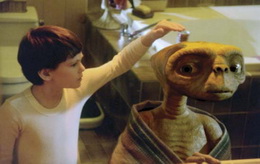
E.T. the Extra-Terrestrial


E.T. the Extra-Terrestrial is found by a little boy called Elliott. E.T. is stranded on earth and Elliot and his siblings help E.T return home while trying to keep it a secret from the government and there mother. Elliott feels the psychic connection with the alien at school. E.T. watches the movie the quiet man and sees a guy kiss a girl so Elliot kisses the girl that he likes. E.T learns to speak English by repeating what Gertie (one of Elliott’s siblings) in response to her watching sesame street. The link between E.T. and Elliott begins to disappear as E.T. begins to die. E.T. reanimates and reveals that its people are returning. Elliott and Michael steal a van that E.T. had been loaded into and a chase ensues, with Michael's friends joining Elliott and E.T. E.T. uses telekinesis to lift Elliott and himself up to escape the authorities and into the forest where the spaceship is.

Monday, April 26, 2010

The Buran Space Shuttle


The Buran spacecraft was the only completed and operational space shuttle vehicle from the soviet Buran the Buran completed one unmanned spaceflight in 1988 before the cancelation of the soviet shuttle program in 1993. The Buran was crushed in a hanger collapse in 2002. The Buran spacecraft was designed for the delivery to orbit and return to Earth of spacecraft, cosmonauts, and supplies. It was piggy-backed on the Antonov An-225 Mriya aircraft, which was designed for this task and remains the longest aircraft in the world. It was lifted into orbit unmaned by the specially designed Energia booster rockets. The only orbital launch of Buran occurred at 3:00 UTC on 15 November 1988 from Baikonur Cosmodrome Site 110/37.


info found on wikipidea

Mir space station


Mir is the first long term inhabited research station in space and the first of third Generation type station constructed from 1986-1996. Eight days short of ten years, and was occupied for a total of twelve and a half years of its fifteen-year lifespan. Mir had the capacity to support a resident crew of three but could also support larger crews for small visits, the largest crew simultaneously aboard the station being six. The station was made accessible for astronauts from the United States several western European countries, Japan as well as cosmonauts from various eastern nations.


info found on wikipideia

Wednesday, April 21, 2010

Neil Armstrong


Neil Armstrong was born on August 5, 1930 on his grandparents’ farm in Auglaize country, Ohio. Neil was the oldest of three children of Stephan and Viola Engel Armstrong. Neil loved airplanes he started liking them at age 6 when he took his first flight in a ford tri-motor “tin goose.” He worked at many jobs by the airport so he could start taking flying lessons at age 15. For his 16th birthday he got his pilots license even before his drivers license Neil was so fascinated by planes he built a wind tunnel in his basement so he could test his model planes.

After graduating from Blume high school in 1947, Neil entered Purdue University with a us scholarship. He began work on an aeronautical engineering degree, but in 1949, he was called to active duty with the navy. He won his jet wings at Pensacola naval air station in Florida at the age of twenty, the youngest pilot in his squadron. He was sent to Korea in 1950 and flew seventy eight combat missions.